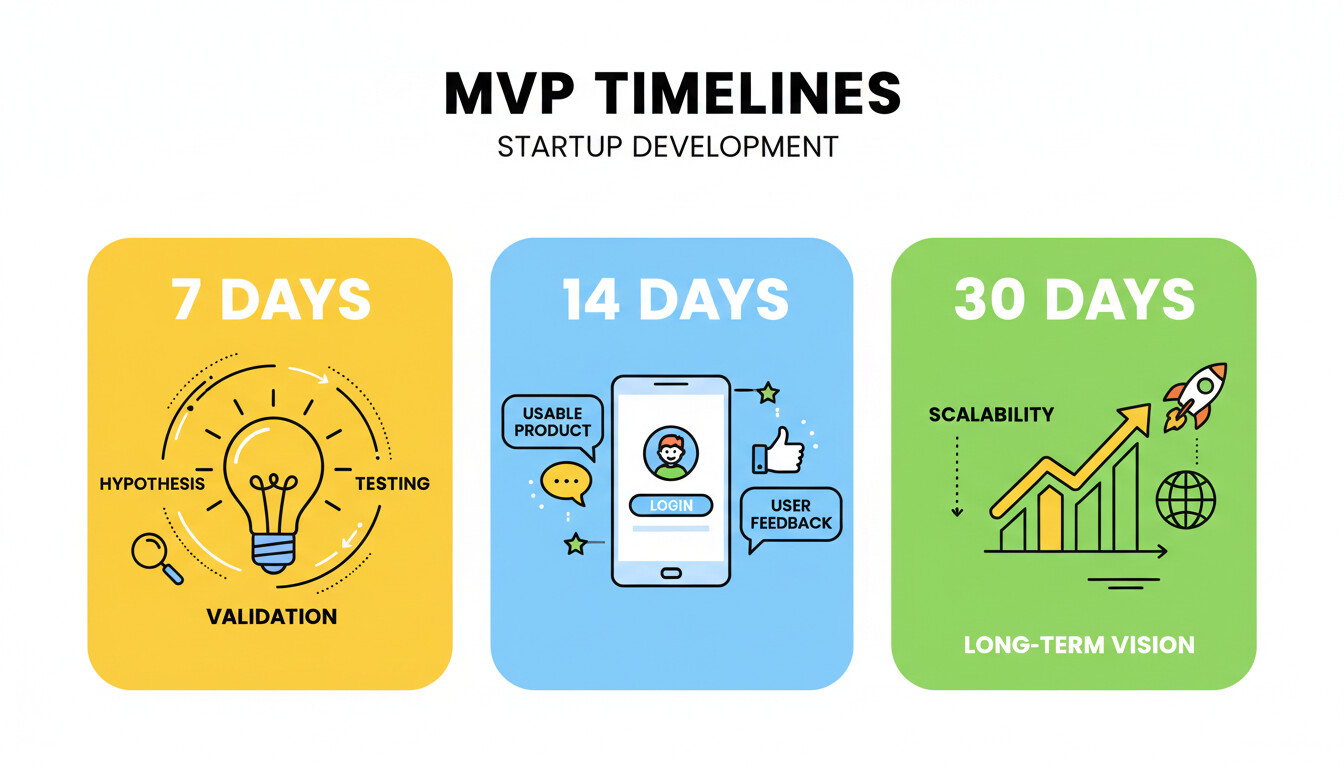
Seven days. Fourteen days. Thirty days. These aren’t arbitrary numbers – they’re the three most common rapid MVP timelines founders ask about. Each represents a fundamentally different approach to what you can build and how you validate your idea.
The question isn’t which timeline is “best.” It’s which timeline matches what you’re trying to accomplish. A 7-day MVP validates a hypothesis. A 14-day MVP delivers a usable product. A 30-day MVP builds something you can grow with.
This guide breaks down exactly what’s achievable in each timeframe, with specific feature scopes, day-by-day breakdowns, and real examples. You’ll know which timeline fits your situation and what trade-offs each requires. For the complete rapid development framework, our rapid MVP development playbook covers the full methodology.
The Three Timeline Philosophies
Before diving into specifics, understand what each timeline represents:
7 Days: Proof of concept. You’re testing whether anyone cares about your idea. Manual processes replace automation. Polish doesn’t exist. You ship the absolute minimum to learn something.
14 Days: Minimum viable product in the truest sense. A real product that real users can use, but stripped to essential features only. The sweet spot for most rapid validation.
30 Days: A foundation you can build on. Still minimal, but with enough infrastructure and quality that you’re not rebuilding immediately after launch. Suitable for products you expect to grow quickly.
The 7-Day MVP: Hypothesis Validation
A 7-day MVP answers one question: “Will anyone actually use this?” Everything else is secondary.
What You Can Actually Build
In seven days, you’re building one of these:
- Landing page + manual fulfillment: Describe your product, collect signups or payments, deliver the service manually behind the scenes
- Single-feature tool: One function, done well, with basic UI
- Wizard of Oz MVP: Looks automated to users, but you’re doing the work manually
- Concierge MVP: You ARE the product, delivering the service personally
Not achievable in 7 days: Multiple features, user accounts with dashboards, payment processing (unless using simple Stripe checkout links), any real-time functionality, mobile apps.
Day-by-Day Breakdown
Day 1: Define and Cut
- Write your core hypothesis in one sentence
- List every feature you imagined – then cut 80% of them
- Pick ONE job your MVP will accomplish
- Choose your tech stack (use what you know, not what’s trendy)
Day 2: Data Foundation
- Set up database schema
- Build basic API endpoints
- Get authentication working (Clerk or Auth0, never build your own)
- No UI yet – backend only
Day 3: Core Feature
- Build the ONE thing that delivers value
- End-to-end workflow must function
- Basic UI – functional, not beautiful
Day 4: User Journey
- Complete flow from signup to core action
- Handle obvious error states
- Add essential copy and instructions
Day 5: Polish Essentials
- Morning: Deploy to production
- Afternoon: Test critical paths
- Evening: Fix breaking bugs only
Days 6-7: Launch Buffer
- Final testing and bug fixes
- Set up basic analytics
- Share with first users
- Collect initial feedback
7-Day MVP Example: Feedback Collection Tool
The hypothesis: Small business owners want a simpler alternative to Typeform for collecting customer feedback.
What got built:
- Create a feedback form with 3 question types (text, rating, multiple choice)
- Generate embeddable link
- View responses in a simple list
- No analytics, no branching logic, no integrations
What validated: 47 businesses created forms in the first week. The hypothesis was worth pursuing.
Who Should Choose 7 Days
- You’re testing a completely unvalidated idea
- Budget is extremely limited
- You’re comfortable with manual processes
- You need to show something to investors immediately
- The core value can be delivered with one feature
The 14-Day MVP: Usable Product
Fourteen days gives you enough time to build something people can genuinely use – not just test. According to Netguru’s analysis of MVP timelines, two weeks represents the minimum viable timeline for products requiring user accounts and multiple interconnected features. If you want help executing on any of these timelines, BuildMVPApp offers fixed-timeline MVP development with experienced teams.
What You Can Actually Build
In two weeks, achievable scope includes:
- 3-5 core features working together
- User authentication with basic profiles
- Simple payment integration (Stripe checkout)
- Basic admin functionality
- Mobile-responsive web app
Not achievable in 14 days: Complex user roles and permissions, real-time collaboration, custom integrations with legacy systems, native mobile apps, AI features requiring custom training.
Week-by-Week Breakdown
Week 1: Foundation + Core
Days 1-2: Setup and Planning
- Finalize feature list (3-5 features maximum)
- Create wireframes for key screens
- Set up development environment and deployment pipeline
- Implement authentication
Days 3-5: Core Feature Development
- Build primary feature end-to-end
- Database schema for all planned features
- API endpoints for core functionality
- Basic UI using component library
Days 6-7: Secondary Features
- Implement feature #2 and #3
- Connect features together
- User dashboard showing relevant data
Week 2: Complete + Launch
Days 8-9: Remaining Features + Polish
- Features #4 and #5 if planned
- Payment integration if needed
- Error handling and edge cases
Days 10-11: Testing + Fixes
- Test all user flows thoroughly
- Fix critical bugs
- Mobile responsiveness check
- Performance optimization basics
Days 12-14: Launch Preparation
- Production deployment
- Analytics setup
- Onboarding flow and initial user guidance
- Launch to early users
14-Day MVP Example: Booking Tool for Consultants
The problem: Independent consultants need a simple way for clients to book and pay for sessions.
What got built:
- Consultant creates account, sets availability and session types
- Shareable booking page clients can access without account
- Client selects time, pays via Stripe
- Both parties receive email confirmation
- Consultant dashboard shows upcoming bookings
Not built (deferred): Calendar sync, reminders, rescheduling, multiple team members.
For specific scope guidance at this timeline, our breakdown of realistic 2-week MVP scope covers what fits and what doesn’t.
Who Should Choose 14 Days
- You’ve validated demand and need a real product
- Users need multiple features to get value
- You want something you can charge for immediately
- Budget allows for $10,000-25,000 investment
- You have an experienced developer or team
The 30-Day MVP: Growth Foundation
Thirty days builds something you won’t immediately regret. You have time for proper architecture, reasonable testing, and features that support growth – not just validation.
What You Can Actually Build
In a month, achievable scope includes:
- 8-12 features across multiple user workflows
- Multiple user types with different permissions
- Subscription billing with plan management
- Admin dashboard with basic analytics
- Third-party integrations (2-3 common ones)
- Email notifications and basic automation
Still not achievable in 30 days: Two-sided marketplaces with full functionality, products requiring compliance certification, custom AI/ML models, native mobile apps for both platforms.
Week-by-Week Breakdown
Week 1: Discovery + Design
- Complete feature specification
- Wireframes and user flow maps
- Design mockups for key screens
- Technical architecture decisions
- Development environment setup
Week 2: Core Development
- Authentication and user management
- Primary feature set (3-4 features)
- Database schema complete
- API foundation
Week 3: Feature Completion
- Secondary features (4-5 more)
- Payment integration with subscription logic
- Third-party integrations
- Admin functionality
Week 4: Polish + Launch
- Testing across all user flows
- Bug fixes and edge case handling
- Performance optimization
- Documentation and onboarding
- Production deployment and monitoring
30-Day MVP Example: Team Task Management
The problem: Small teams need Asana-like functionality without Asana complexity or pricing.
What got built:
- Team workspaces with member invitations
- Projects containing tasks with due dates and assignees
- Kanban board view and list view
- Comments on tasks
- Email notifications for assignments and mentions
- Basic reporting (tasks completed this week)
- Subscription billing with free tier
Deferred to post-launch: Time tracking, Gantt charts, integrations beyond Slack, mobile app.
Who Should Choose 30 Days
- You’re building a SaaS you expect to grow
- Multiple user types need different experiences
- You need subscription billing from day one
- Budget allows for $25,000-50,000 investment
- You want infrastructure that scales
Timeline Comparison Summary
| Factor | 7 Days | 14 Days | 30 Days |
|---|---|---|---|
| Features | 1-2 | 3-5 | 8-12 |
| User Accounts | Basic or none | Yes | Multiple types |
| Payments | Manual/links only | Simple checkout | Subscriptions |
| Polish Level | Functional only | Decent UX | Production quality |
| Cost Range | $2,000-8,000 | $10,000-25,000 | $25,000-50,000 |
| Best For | Hypothesis testing | Market validation | Growth foundation |
For detailed cost breakdowns by timeline, our guide to rapid MVP development pricing covers what each investment level delivers.
How to Choose Your Timeline
Answer these questions to find your fit:
Choose 7 Days If:
- You haven’t validated that anyone wants this yet
- You can deliver core value with ONE feature
- You’re willing to do things manually
- Budget is under $10,000
- You need something to show investors this week
Choose 14 Days If:
- You’ve validated demand through research or pre-sales
- Users need 3-5 features to get real value
- You want to charge money immediately
- Budget is $10,000-25,000
- You have access to experienced developers
Choose 30 Days If:
- You’re confident in product-market fit direction
- Multiple user types or complex workflows are required
- You need subscription billing infrastructure
- Budget is $25,000-50,000
- You want a foundation that scales without immediate rebuild
Common Mistakes by Timeline
Each timeline has predictable failure modes:
7-Day Mistakes
- Trying to build too many features – You have time for ONE thing done well
- Spending days on design – Functional beats beautiful at this stage
- Building automation you could do manually – Save automation for after validation
14-Day Mistakes
- Scope creep during week 2 – Lock features by day 3
- Underestimating testing time – Reserve 3+ days for QA and fixes
- Building nice-to-haves before must-haves – Prioritize ruthlessly using frameworks like MoSCoW or RICE
30-Day Mistakes
- Over-engineering for scale you don’t have – Build for 100 users, not 100,000
- Treating it like a full product build – It’s still an MVP
- Skipping validation because you have “more time” – Validate early, even with 30 days
For guidance on finding developers who can hit these timelines, hiring MVP developers covers what to look for and where to find them.
Extending Your Timeline Strategically
Sometimes the right answer is somewhere between these milestones. According to Adam Fard’s timeline analysis, the average successful MVP takes 3-4 months – but that includes discovery phases many founders skip when they have clear direction.
If 14 days feels too tight but 30 seems excessive, consider a 21-day timeline: two weeks of development plus one week of dedicated testing and polish. This often hits the sweet spot for SaaS products.
Frequently Asked Questions
Can I really build something useful in 7 days?
Yes, but “useful” means solving one specific problem, not building a complete product. Buffer validated their concept with a landing page in days. Airbnb’s first version was founders manually handling bookings. The goal is learning, not perfection.
What if I start with 7 days and need more time?
That’s fine – and common. A 7-day sprint often reveals what’s actually needed for a 14 or 30-day build. The learning from shipping something basic informs better decisions about what to build next.
Is 30 days still considered “rapid” MVP development?
Compared to traditional 3-6 month timelines, absolutely. Thirty days gets you a real product while most teams are still in planning meetings. The key is maintaining MVP discipline – building only what’s necessary for validation, not a full product.
How do I prevent scope creep within these timelines?
Write down your feature list on day one and treat it as locked. Every addition requires removing something else. Daily standups help catch scope drift early. If a new feature seems essential, it probably belongs in version 2, not the MVP.
Have questions about choosing your MVP timeline? Drop a comment below – we read and respond to every one.
Leave a Reply